Softball team warming up before a game.

Every kid deserves a fair shot. GameCard makes sure they get one.

Fair playing time is one of the biggest sources of parent friction in youth sports, and one of the hardest things to manage by hand. GameCard builds every lineup so every player gets their fair share automatically, every game.

Get Started Free

Why fair playing time is so hard by hand.

You Can't Remember Everything

Who played shortstop twice last week? Who's been in the outfield four games in a row? Which player has had the most bench time this season? These are impossible questions to answer from memory, especially when you're also managing a game, a team, and a group of parents.

Spreadsheets Break Down Fast

Coaches who try to track this in a spreadsheet spend 45 minutes per game cross-referencing who played where. And one absent player throws the whole thing off. By mid-season, most coaches have stopped tracking and are just guessing.

The Parent Who Keeps Score

Every team has a parent who actually is tracking. If your lineups aren't defensible, they'll let you know, and so will everyone else in the group chat. Fair playing time isn't just about the kids. It's about avoiding the conflict that comes when it looks unfair.
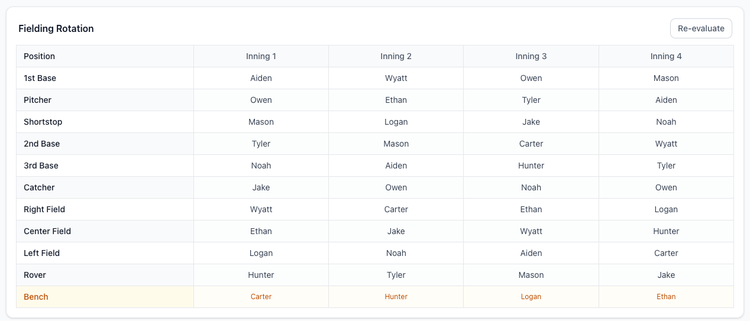
Screenshot: Coach game page showing the full rotation grid — every player, every inning, fair position distribution visible across the whole game

Fair rotation, built into every lineup.

GameCard's algorithm is built to spread positions fairly across your roster. It knows which positions each player is eligible for, their fielding rank, and any performance updates you've added, and balances all of that against built-in fairness rules every time it generates a lineup.

No player gets stuck at the same position game after game. You don't need to track a thing.

Fair doesn't mean random.

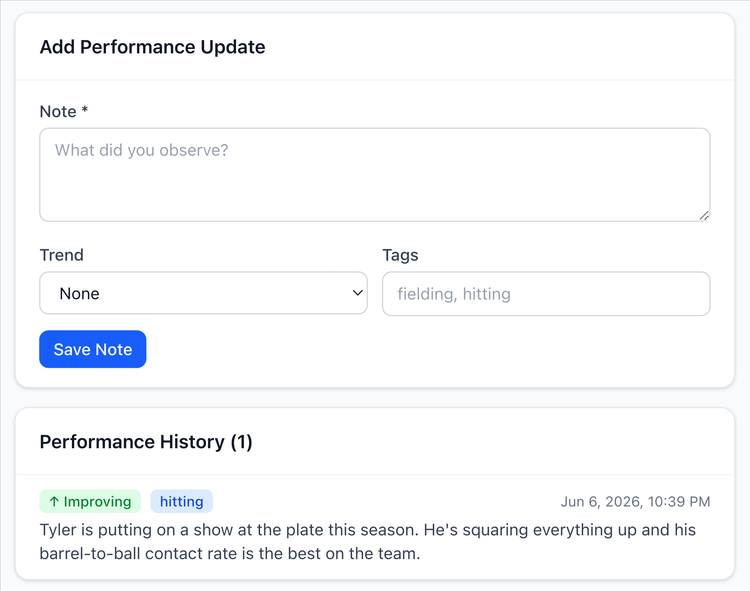
Every player profile carries a Hitting Rank, Fielding Rank, Primary Positions, Secondary Positions, and Playing Restrictions. Add Performance Updates throughout the season — tag a note as Improving or Declining and the algorithm adjusts how it evaluates that player going forward.

The result: the best available player lands at each position every game, while every player still gets their fair share of the rotation.
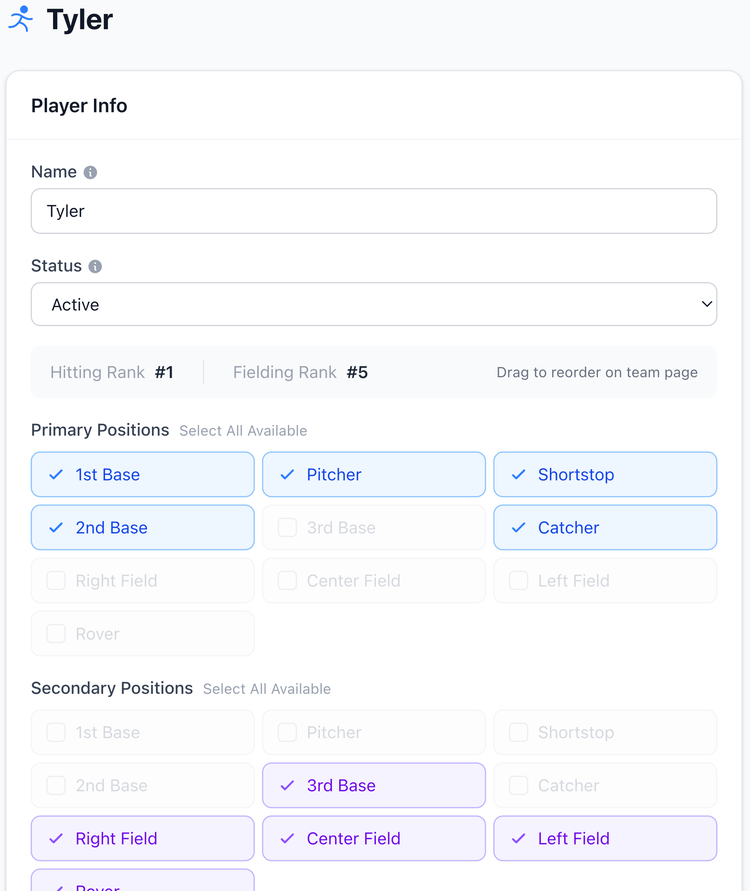
Screenshot: Player profile page showing hitting rank, fielding rank, primary and secondary positions

Screenshot: Player performance updates.

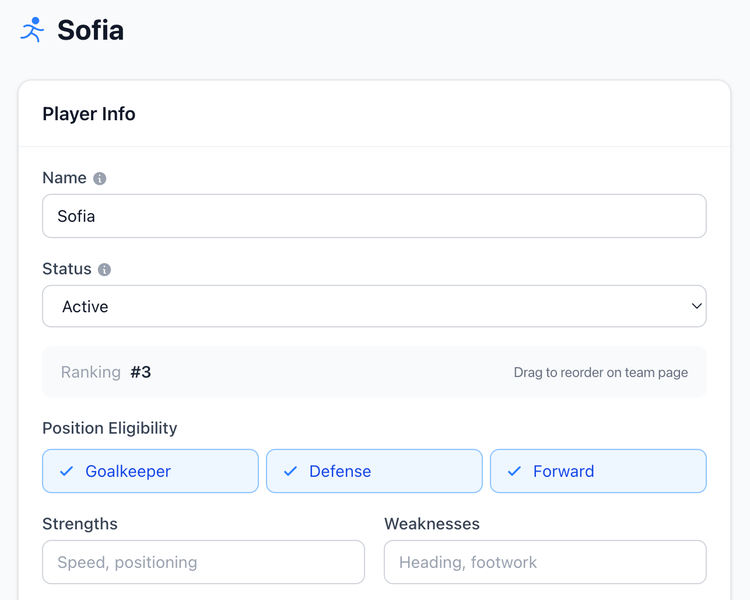
Screenshot: Player profile showing goalkeeper eligibility

Goalkeeper rotation handled fairly.

In soccer, goalkeeper is the hardest position to rotate fairly, especially when some players don't want to play it. GameCard manages goalkeeper rotation so the duty is spread fairly across all willing players, automatically.

Players who don't want to play goalkeeper are marked once on their profile. They never get put in goal. Everyone else rotates through fairly without you having to think about it.

More about GameCard for Soccer →

You control how skill and fairness are weighted.

Rotation Style: Use player rankings — or ignore them entirely and rotate everyone equally.

Bench Rotation: Weakest player always sits, or rotate bench duty evenly across the whole season.

Position Repeat: Always rotate positions, allow repeats when the rotation benefits from it, or let specialists stay at one position every inning.

Changing any setting recalculates all future rotations automatically. Past games are never affected.
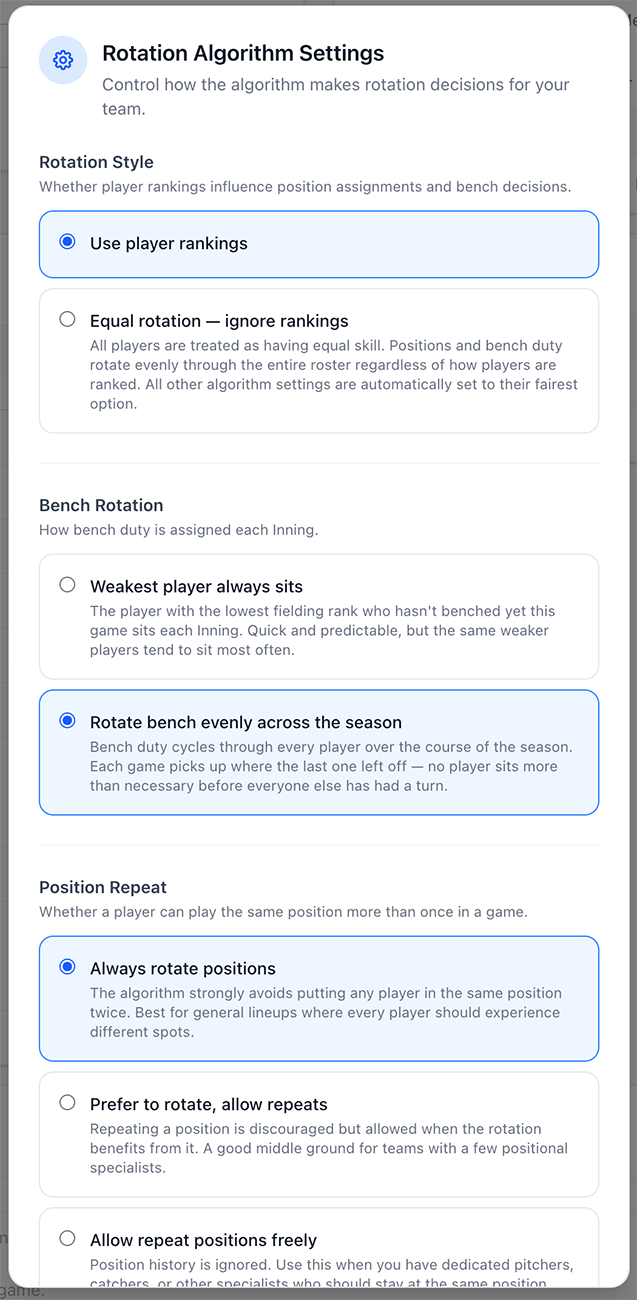
Screenshot: Configurable fairness algorithm for coaches.
I used to spend 45 minutes before every game figuring out who played what last week. With GameCard, it takes 30 seconds and it's more fair than anything I could build by hand.
Coach Dan, 9U Baseball, Naperville IL

Fair playing time questions.

Does GameCard guarantee perfectly equal time at every position?
GameCard optimizes for fairness in every game. The algorithm spreads positions across your roster, but not necessarily with perfect equality in every single inning. A player might play shortstop twice in one game if attendance is low. The algorithm balances fairness with your player rankings to produce lineups that are both defensible and competitive.
Can I override the lineup if I need a specific player in a specific spot?
For the batting order in baseball and softball, you can drag players to reorder it directly. For the fielding rotation, adjustments work through your roster data: change attendance, update a player's rankings or performance notes, then re-evaluate to regenerate the rotation with those changes factored in.
What if a player misses a game?
When a player is marked absent, GameCard builds the rotation around whoever is there. When they return, they're included normally in the next lineup. The algorithm generates a fair rotation from your current roster every time.
Can parents see the lineup?
Lineup details and fielding rotations are visible to coaches only. Parents see the schedule and game logistics, not the lineup. As head coach, you can see every game's rotation and walk any parent through how the lineup was built if they have questions about their player's playing time.
Does this work for bench rotation in soccer?
Yes. The Bench Rotation setting lets you choose whether the weakest fielder sits or if bench time rotates evenly across the team, and the algorithm enforces it consistently every game.
Young baseball players celebrating together on the field

Give every kid their fair shot — automatically.

GameCard's algorithm builds every lineup to give every player their fair share, every game, without a spreadsheet. No mental math, no parent complaints. Free to start, no credit card required.

Get Started Free